

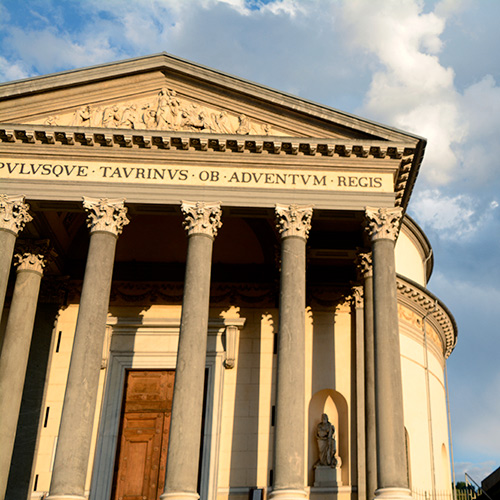
The history of the Church of the Great Mother of God, one of the symbols of Turin, begins in the period of the fall of Napoleon: with the Treaty of Paris of May 30, 1814, the power of the House of Savoy was reestablished, and on August 30, 1814, the city council had decreed to celebrate the return of Victor Emmanuel I to the capital of the Kingdom of Sardinia with special celebrations and, above all, with the erection of a temple dedicated to the Great Mother of God. The project was entrusted to the architect Ferdinando Bonsignore (who was inspired by the Pantheon in Rome for the image of the church) and on July 23, 1818, the foundation stone was laid, although the work proceeded far from expeditiously, even knowing an interruption of about nine years (the construction site resumed only in 1827, under the reign of Charles Felix). The building was completed in 1831 and inaugurated on May 20 of that year, in the presence of King Charles Albert. The church appears as a sumptuous neoclassical building with a circular plan, preceded by a hexastyle pronaos (with six columns), inside which are two more columns, one on each side, flanked by three pillars. All the columns have Corinthian capitals. The temple is accessed by a wide flight of steps, in front of which is the monument to Victor Emmanuel I.
It was Victor Emmanuel I himself who stipulated that mainly local marbles, and in particular marbles from the Monregalese area, be used for the church. Thus the interior columns are in breccia di Casotto, the bases of the latter are in dark bigio di Frabosa. Seravezza from Moncervetto, on the other hand, was used extensively as a base for the altars and balustrades.